
As artificial intelligence (AI) systems become increasingly embedded in critical decision-making across healthcare, finance, defense, and more, the need for rigorous testing of their ethical boundaries has never been more pressing. While traditional testing focuses on performance, accuracy, and safety, a new discipline is emerging to probe AI systems from a different angle: AI red teaming.
What is AI Red Teaming?
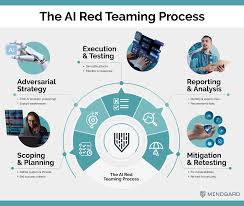
AI red teaming borrows from cybersecurity’s long-standing tradition of pitting ethical hackers (red teams) against systems to expose weaknesses before malicious actors can exploit them. In the AI context, red teaming refers to structured, adversarial testing of machine learning models and AI systems to identify vulnerabilities, especially those with ethical, social, or safety implications.
The goal is not just to make AI more robust, but to uncover how these systems might behave in unpredictable or harmful ways—particularly in high-stakes or ambiguous scenarios. This includes testing for biased outputs, manipulation through adversarial prompts, and edge-case failures.
The Role of Adversarial Testing
At the core of AI red teaming lies adversarial testing, a technique that systematically pushes AI systems to their limits. By crafting challenging inputs—whether linguistic, visual, or behavioral—testers can provoke unintended or problematic outputs. For example, a red team might attempt to elicit harmful recommendations from a chatbot, or try to manipulate a vision model into misclassifying images in a way that could have real-world safety implications.
This approach differs from standard QA processes, which typically assume “happy path” usage. Instead, adversarial testing confronts AI systems with worst-case scenarios, edge cases, and ethically charged inputs that force designers to confront their models’ limitations.
Introducing the Carlo Audit Sandbox
One of the key innovations accelerating ethical AI testing is the Carlo audit sandbox—a controlled environment for running AI red teaming exercises. Named to evoke rigor and transparency, the Carlo sandbox allows organizations to simulate complex user interactions and assess the ethical resilience of AI systems without risking real-world harm.
Within the Carlo audit sandbox, developers and ethicists can orchestrate adversarial scenarios, log model responses, and evaluate them using custom metrics for fairness, safety, accountability, and compliance. It acts as a proving ground for both AI developers and third-party auditors seeking to verify the trustworthiness of a system before it is deployed at scale.
Why AI Red Teaming Matters Now
The increasing capability of generative AI and autonomous agents brings not only innovation but also heightened risk. As these systems begin to write code, make predictions, or even manage other AI tools, understanding how they could be misused—or simply fail under pressure—becomes critical.
AI red teaming ensures that ethical considerations are not an afterthought but a foundational part of the development lifecycle. By confronting AI with its own blind spots in a safe environment, organizations can better align their technologies with societal values and legal norms.
Looking Ahead
AI red teaming is still a developing field, but its potential is vast. Initiatives like the Carlo audit sandbox provide much-needed infrastructure to institutionalize ethical AI testing. Going forward, red teaming may become a standard requirement for AI certification and regulation, especially as governments and industry bodies call for greater AI accountability.
As AI systems grow more complex, their ethical testing must keep pace. Red teaming for AI isn’t just a security measure—it’s a new frontier in responsible innovation.